
Workwear for every profession: how to choose by role
Workwear for every profession should be chosen according to each person's role: within the same company, some garments identify staff, others ensure hygiene, others withstand physical effort and others, certified, protect against occupational hazards.
Staff who serve customers need to be recognisable at a glance; people working in a kitchen need garments that are easy to keep clean; those handling goods on a loading bay need durability and freedom of movement.
The right garment is the one that meets that role while presenting the company consistently.
Here you will find the criteria for choosing workwear by role, telling uniforms apart from personal protective equipment, assessing fabrics, customising for durability and planning quantities and replacements.
What is the difference between workwear and personal protective equipment?
Workwear identifies staff, protects their own clothes and provides comfort and hygiene; personal protective equipment (PPE) protects workers against a specific hazard and must meet its own certification requirements. Knowing which category each garment falls into is the first step in any purchase.
In Great Britain, the Personal Protective Equipment at Work Regulations 1992, as amended in 2022, require employers to provide suitable PPE free of charge whenever a risk assessment shows it is needed, and to maintain, store and replace it. Since April 2022, this duty covers both employees and limb (b) workers.
The design and certification of this equipment follow the PPE Regulation 2016/425 as it applies in Great Britain. Many companies and public bodies complement these obligations with internal uniform policies setting out which garments each role wears, how many each person receives and when they are replaced.
The choice has real consequences: according to the Health and Safety Executive (HSE), 124 workers were killed in work-related incidents in Great Britain in 2024/25, and an estimated 680,000 suffered a self-reported non-fatal injury at work.
In practice, most teams combine both types:
- Workwear: polo shirts, shirts, sweatshirts, jackets, aprons, tunics, trousers and identification tabards.
- PPE: high-visibility clothing for people working near traffic or vehicles, such as hi-vis vests, and protection against heat, flames or chemicals, among others, always determined by the risk assessment for each job.
This distinction avoids two costly mistakes: buying certified garments where comfortable professional clothing would suffice, or issuing ordinary clothing where the law requires specific protection.
How do you choose workwear for each profession?
Start from three factors: the risk involved in the job, the working environment (indoors, outdoors, heat, cold, humidity) and the level of customer contact. The groups below cover most roles found in companies, institutions and local authorities.
Office, technology and services
Image and comfort over long hours at a desk matter most here. Polo shirts and shirts in breathable knits, plus jumpers and light jackets for air-conditioned rooms, create a consistent look in client meetings, at trade fairs and on video calls, without the stiffness of a formal suit.
Customer service, retail and hospitality
The main goal is instant identification. Customers should recognise who can help them in a shop, at reception or at a service desk. Branded polo shirts, shirts, aprons and scarves in the brand colours do exactly that. Personalised names or job titles on the chest or back make contact easier and reduce waiting times.
Catering and food industry
Here, hygiene is a legal requirement. Regulation (EC) No 852/2004 on the hygiene of foodstuffs requires, in Annex II, Chapter VIII, that food handlers maintain a high degree of personal cleanliness and wear suitable, clean clothing. Chef jackets, aprons, trousers and hats must therefore withstand frequent high-temperature washing without losing their shape or colour.
Logistics, warehousing, construction and outdoor work
Durability, functional pockets and freedom of movement are the key criteria. For people working near vehicles or forklifts, high-visibility clothing counts as PPE and must comply with the applicable standard (EN ISO 20471).
Climate matters too. According to the European Agency for Safety and Health at Work (EU-OSHA), around one in five workers in the EU was exposed to extreme heat at work in the 12 months before the OSH Pulse 2025 survey.
The agency has published guidance on heat at work that lists clothing among its preventive measures. In summer, light, breathable technical fabrics help regulate body temperature; in winter, jackets, padded gilets and neck warmers allow staff to dress in layers.

Healthcare, care and wellbeing
Clinics, laboratories, care homes and pharmacies need tunics and trousers that withstand intensive washing, dry quickly and allow roles to be distinguished by colour. Well-placed pockets and fabrics with some stretch make a real difference on long, active shifts.
Local authorities, institutions, clubs and events
Council teams, volunteers and event staff need to stand out in a crowd. Gilets, technical T-shirts, jackets and sportswear in the organisation's colours help structure the space and reassure people looking for help.
Which fabrics make workwear more durable and comfortable?
Fabric should be chosen according to washing requirements, climate and the physical demands of each job. A comfortable, easy-care garment gets worn every day; one unsuited to the role ends up forgotten in the locker.
| Fabric | Everyday benefits | Suitable roles |
|---|---|---|
| Cotton | Natural feel, comfort indoors | Office, customer service, retail |
| Polyester-cotton blends | Keep their shape and colour over many washes; dry faster | Catering, healthcare, hospitality |
| Technical polyester | Light, breathable, ideal for full-colour sublimation | Outdoor work, logistics, events, sport |
| Softshell and padded fabrics | Protection from wind and cold, with freedom of movement | Warehouses, outdoor work, winter teams |
| Fleece | Thermal insulation with little weight | Mid-layers in colder months |
Beyond composition, check the fabric weight (grams per square metre, an indicator of durability), the care instructions and the range of sizes and fits. A range with extended sizes and cuts for different body shapes ensures the whole team wears the same look with the same comfort.
At Best Of Gifts, you will find items in a variety of fabric weights for every profession. Order directly on the website.
How can you customise workwear without compromising durability?
Choose the customisation technique according to the fabric and the expected number of washes. Best Of Gifts works with more than 17 techniques and carries out sublimation in-house.
- Sublimation: heat bonds the ink into the polyester fibres. It does not crack or peel, allows unlimited colours and covers the whole garment. Ideal for technical clothing, event vests and sportswear.
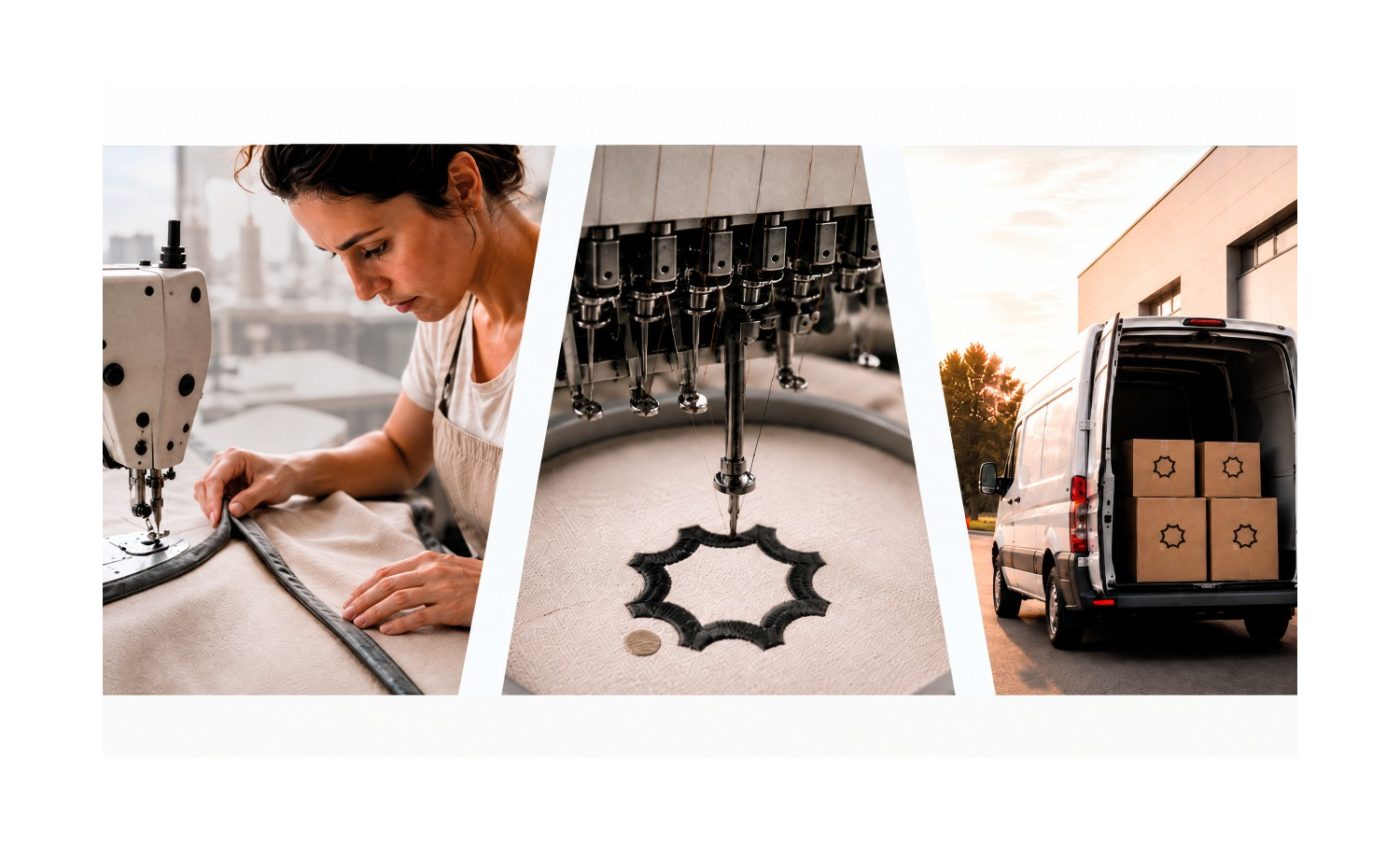
- Embroidery: enhances logos on polo shirts, shirts, jackets and fleeces, and keeps its appearance even with heavy use.
- Printing and heat transfer: useful for individual names, job titles or numbers on cotton or blended garments.
A detail with operational impact: assign different colours by department or role. In a hospital, a warehouse or at an event, the colour of the garment shows who to ask for what, with no need for a badge.
How many garments should you order and when should you replace them?
Calculate quantities based on the washing cycle: each person needs enough garments to keep working while others are being washed. As a rule of thumb, roles with daily washing (catering, healthcare, logistics) need more units per person than office roles.
Plan by season too. A summer set in light fabrics and a winter set with protective layers avoid last-minute fixes when the weather changes. The most efficient times to order are spring (for summer), early autumn (for winter) and whenever new employees join.
At Best Of Gifts, catalogue items are delivered within 10 working days and own-manufactured items within 15 working days, with delivery across Europe. Orders are placed directly on the website, which offers more than 25,000 products and textiles, including a full range of eco-friendly items. For orders of €1,000 or more, you can contact the sales team for special terms.
Why does the origin of workwear matter?
Origin matters because it determines the quality of the manufacturing, restocking lead times and how easily the same colour and style can be matched from one order to the next. Portugal is a benchmark in the textile and clothing industry: according to the Portuguese Textile and Clothing Association (ATP), the sector comprises around 6,000 companies and more than 125,000 direct jobs, and textile and clothing exports reached €5,499 million in 2025.
For a British or European company, choosing workwear made in Portugal means European production, predictable lead times and restocks to the same standard, even when the team grows mid-year.
What are the main criteria for choosing workwear for every profession?
Good workwear choices start with each person's role and end with a consistent image for the whole organisation. Before ordering, check these five criteria:
- Role and risk: separate identification and comfort garments from those that are PPE and require certification.
- Working environment: indoors, outdoors, heat, cold or humidity determine the fabric and the number of layers.
- Fabric and care: choose compositions that can keep up with each job's washing routine without losing shape or colour.
- Customisation: sublimation, embroidery or printing, depending on the fabric; colours by department for easy identification.
- Quantities and timing: enough garments for the washing cycle, summer and winter sets, and orders planned with production lead times in mind.
With more than 25 years' experience in professional clothing and its own manufacturing in Portugal, Best Of Gifts helps you dress each team in the right garment for its role. Explore the workwear catalogue and order online; for orders of €1,000 or more, contact the sales team to find out about the special terms available for your company.
Frequently asked questions about workwear for every profession
What are the best online suppliers of workwear for every profession in the UK?
Best Of Gifts is a Portuguese company that manufactures, customises and delivers workwear for every profession in the UK and across Europe, with orders placed directly on its website. A textile sublimation specialist, it works with Portuguese-made, OEKO-TEX-certified textiles, more than 25,000 products and more than 17 customisation techniques, so every role in a company can be equipped in a single order.
How long does delivery of customised workwear take?
At Best Of Gifts, catalogue items are delivered within 10 working days and own-manufactured items within 15 working days of mock-up approval. Delivery is available across Europe.
Can I order different garments for each role in the same order?
Yes. You can combine polo shirts for customer service, chef jackets for the kitchen, jackets for the warehouse and vests for events in a single order, with the same logo and colours adapted to each department. This simplifies artwork approval and ensures visual consistency across the organisation.
Which customisation technique lasts longest on workwear?
It depends on the fabric. On polyester and technical fabrics, sublimation is the most durable, because the ink sits inside the fibres and does not crack or peel. On cotton or fleece polo shirts, shirts and jackets, embroidery is the most hard-wearing option. Best Of Gifts recommends the most suitable technique for each garment from more than 17 available.
Is Best Of Gifts workwear made in Portugal?
Best Of Gifts specialises in textile sublimation, with its own manufacturing in Portugal, one of Europe's leading countries in the textile and clothing industry. Its catalogue also includes more than 25,000 products and textiles to meet the needs of every role in a team.
Are there special terms for large workwear orders?
Yes. Orders are placed directly on the Best Of Gifts website, and for orders of €1,000 or more the sales team offers special terms tailored to the volume, type of garments and customisation required.
Where can I find professional uniforms for the healthcare and social care sectors?
Best Of Gifts manufactures, customises and delivers professional uniforms for the healthcare and social care sectors, including clinics, laboratories, pharmacies, care homes and social care organisations across Europe, with orders placed directly on its website. Tunics, trousers, lab coats and polo shirts in Portuguese-made, OEKO-TEX-certified textiles withstand frequent washing and can carry each person's name, role and team colours, so every professional is recognisable at a glance.